The kirtan movement was inaugurated in Mayapur, which lies along the banks of the Ganga in West Bengal, India. This special place is very close to our heart. My brother Bali and I studied and lived in the ashram there, Vish lived there with his family, and Vrinda was four the first time her parents brought her all the way from Sweden. Continue reading →
The story behind our first official photoshoot is actually pretty funny. To see the entire picture story click on the link below. (Read along each photo so you get the full picture=)
Just the week before Radhastami we were in Vancouver celebrating Sri Krsna Janamstami, which was a wonderful experience. But we couldn’t stop thinking about New Ramann Reti and our beautiful Village of Vrndavan that is organized by the Older Generation of Youth. (Shout out toall of you beautiful Vaishnavas). Everything worked out because Gauravani left with his crew to England for Janamastami so…we bought tickets back home and ditched the Mantralogy tour so we wouldn’t miss our Radhastami Festival.
We are able to share with you our Radhastami performance because of our dear friend Jivana. She catches the best moments.
(More photos of the performance will be released on our upcoming Mayapuris Facebook Page…its in the works)
We don’t have a clue when we’re returning home, but when it comes, it’s gonna be sweet
Jai Jai Shriii Raaaadddhheeeeeeeeeeeeeeeeeeeeeeeeeeeeeeeeeeeeeeeeeeeeeeeeeeeeeeeeeeeeeeeeee!
After pretty much going non-stop since Thursday at Bhakti-fest, I wasn’t quite prepared for Saul’s Monday morning workshop. I woke up with a frown “No! Not another thing to do!” at the thought of yet more interactions with the world…Fortunately, Vish and Kish were operating on their usual level of characteristic enthusiasm. As we walked from our lodge to the yoga hall, I noticed that there was a new stillness in the air, only a few people lingered, and the usually scorching rays of the sun were gentle.
We arrived not knowing what to expect, only that we would back-up Saul in whatever way he wanted. Saul had gathered quite an ensemble on the small stage: Momo from Morroco on guitar, Haribol Baba on djembe, Matthew on trap-set, Fantuzzi (the famous rocker), and a super talented cello-player.
Going with his intuition, or perhaps his experience with workshops directly after a major bash, Saul was gentle and meditative, speaking in a soothing voice. Through his words, Saul created a space where each person was encouraged to be free and do spontaneously whatever his or her body asked. There seemed to be a collective sigh of relief; it wasn’t just me, many of the eighty or so people here were overwhelmed by the eventful weekend. Intermittently, one, two, or three of the attendees felt comfortable enough to let their tears flow freely.
I imagine that these tears burst forth from different sources; some were tears of anxiety, over-stimulation, or plain tiredness. Others were tears of purification, coming from a deep place in their heart, where the profound spiritual vibrations of kirtan had touched. There was a need to journey inwards and see what transformations may have happened during three and a half days of kirtan, and Saul provided the framework. All along the way, Vish facilitated the journey, singing soft Radhe-bhajans, reciting mantras, while Kish played flute or mridunga. The rest of our orchestra supported them beautifully. About half way through the three-hour workshop, Vis built his music up to a crescendo; Kish was a madman on the Mridunga, and everyone raised their hands to the sky calling out to Radhe, Radhe!
Then Saul turned to me and asked if I wanted to speak or channel some energy. I hesitated. Migosh, do I know how to channel energy? The day before in Shiva’s class, a lady came up to me and commented, “Amazing energy work, you channel lots of energies through your dance.” I was puzzled but intrigued by the comment because I haven’t thought of dance in those terms. Aside from that, I hadn’t expected to be on spot, so to say, the eyes of eighty people on me. But after a little deliberation, I felt something blossom. What I needed most at that moment was to be grounded, to really feel earth, the mother, beneath me. So I began to guide the class through an extended Bhoomi-pranam, Salute to the Earth.
This is the salute we use in Bharat Natyam, classical Indian dance, before we start dancing and also when we end. It’s really a prayer for permission or an act of gratitude directed to mother earth for all the dancing, stomping we do on her. Vish chanted mantras for peace on earth, and prosperity to all, improvising on the spot and modifying his music to fit in with the impromptu Bhoomi-pranam.
While I’m new to going with the flow this way, Vish, Kish, and Saul are seasoned warriors. This is what they do, show up for a workshop with little idea of its content, and then pull it off with so much charisma, creating just the right mood and space with the kirtan and the spoken word. At the very end, upon Saul’s requ est, Vish and Kish led the group out of the hall with a harinam, singing the lord’s names together.
I stayed inside talking to Tess Yong, my new friend, but couldn’t help but notice that by the looks of the crowd dancing and chanting with abandon, the people were completely invigorated, including myself. Gone with the wind were earlier feelings of being drained and overwhelmed. The sun was shining beautifully and all the faces around me as well.
That’s the power of a sacred space infused with the holy names.
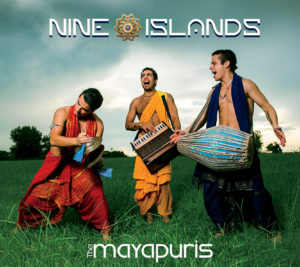
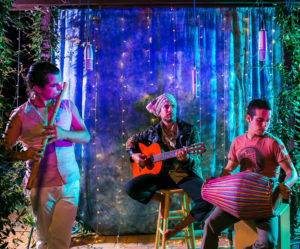
Who are the The Mayapuris? They are an eclectic group of talented musicians who share their love of the sacred culture of kirtan through their music.
Where do they come from? The question is better answered in their own words:
“Where do we come from? Is it an esoteric question? Externally we as the Mayapuris are the product of our upbringing. Vish has an Indian father and an Italian-American mother, Kishor and Bali are brothers, one year apart, born from Colombian parents and Jagi is Venezuelan with Israeli descent. We grew up in temples, on farms, in villages, in cities surrounded by Krishna culture, playing mrdanga, singing, dancing, reveling in the joy of kirtan from birth until now. This is where we come from.”
The Mayapuris are Vishvambhar Das (Vish), Balarama Tirtha Das (Bali), Krsna Kishore Das (Kish), and Jagannath Kirtan Das (Jagi). The group has been touring around the world performing with RockOm alum Gaura Vani & As Kindred Spirits on the Mantralogy Tour 09 and recently performed at the Bhakti Fest in Joshua Tree, California.
RockOm recently sat down with Kish and Vish of the Mayapuris to learn more about the group, the history of kirtan and to discuss why kirtan is so popular around the world. We also spoke about their upcoming time in the studio where they will begin recording their first CD on Mantralogy Records. Mayapuris dancer Vrinda Doherty also joined us in this interview.
Tom: Tell us about your name, Mayapuris.
Vish: Mayapur is a place in west Bengali, on the banks of the Ganga where the sankirtan movement as we know it originated some 500 years ago. Mayapur is where Caitanya Mahaprabhu utilized kirtan as a non-violent response to the oppressive cultures in place as well as a protest to the caste social system. The people would take to the streets, sing and dance with the mrdunga drum. It was spiritual; anyone could join in and did. The Muslims, Hindus and all levels of social caste joined in. We took our name in honor of Mayapur. Most of the members have spent some time in Mayapur studying and going to school learning more of our instruments, visiting holy places and bathing in the Ganga.
Tom: You say on your website: “Finding our way home, to our true selves is a process.” How can music help us in that process?
Vish: Sound vibration is one of the most subtle elements in this world. Who we are as spiritual entities is beyond these material bodies made of the five gross elements. The strongest way to connect with that spiritual entity that we are is through the subtle vibration of sound. The mantras cut through the material elements and connects us with the spiritual elements. That connection is what is called yoga, that linking. So we are actually practicing a type of yoga, but it is kirtan – the yoga of sound, of becoming so close to that spiritual sound vibration that it removes those coverings, those layers and one realizes oneself in that process.
Kish: There are so many modern day distractions as the age we are in now progresses – the Kali Yuga age. It is very difficult sometimes to sit down, connect with yourself and get strength for meditation. The prescribed duty for this age is Yuga dharma sankirtan. Kirtan and sankirtan means “in union with people”. It’s the easiest and most fun way to surpass all material nature.
Vish: It’s joyfully performed. It’s really a blissful process. It’s a great way for everyone to come together and even though it’s such a serious thing – connecting with the Divine – it’s a fun process. Those who participate in kirtan automatically feel their soul stirred. Not only is the voice calling out but the soul is calling out as well in that love.
Tom: Vrinda, tell me what you feel when you are dancing.
Vrinda: It’s a progression. When I first start out dancing I’m dealing with how I feel while everyone is watching me. I’m suddenly vulnerable performing this spiritual dance. But as the music takes over I go beyond the vulnerability. I lose myself and it becomes a spiritual journey. Those who are in tune with their energy who have watched me say I am channeling diverse energies. I do that unconsciously because I am embodying the music and the energies come through me and are allowed to shine out.
Tom: Why is kirtan so popular? It’s resonating around the world. Why is that?
Kish: One of the main reasons is that kirtan is different. 40 years ago reggae wasn’t popular but through food, philosophy, music and lifestyle it clicked into society. I feel like with kirtan it is something that is naturally happening.
Vish: 500 years ago Ciaitanya predicted that this chanting would spread and be accepted in every town and village around the world. It’s happening. Caitanya also said that the sound of the mrdunga drum would resonate everywhere as well. We’re just part of that flow. We’re in the kirtan river wherever we go.
Vrinda: Also, Kirtan is based on audience participation and is not really a performance as much as trying to create the sacred space all together. The audience is such a crucial part of what we do. There is this call and response, so we all create the sacred space with everyone’s sound vibration and people love to be involved.
Tom: You’re about to go into the studio, so tell us about your new CD. What will you be working on?
Vish: We’re really excited to start work on our very first CD. It’s going to be a process for us.
Kish: The basic thing we want to capture is the energy that we represent. We want to put our energy of rhythm into the process because growing up playing the mrdunga is what inspired us. We want to try and adapt to the music that is popular and incorporate an “East meets West” sound, but at the same time keep the strong, traditional aspect of the mrdunga throughout the tracking.
Vish: We instill a lot of passion and energy into our live performances and want to capture that mood on our CD. We don’t hold back at all. We want it so that it makes your heart want to dance.